|
You are here: Marine Templates and Tutorials > Marine Hull Template > Modelling Marine Vessel > Wave Motions
|
Wave Motions
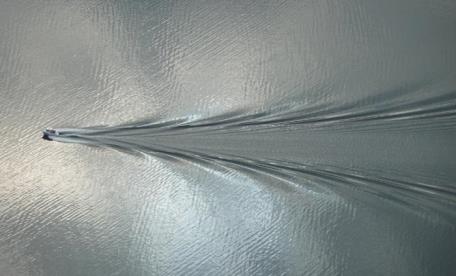
The ship/vessel creates dispersive wave patterns in deep water as the hull pierces the water surface. Such patterns are known as the Kelvin waves. They result in resistance against the ship's forward motion and the marine vessel loses a large fraction of energy to these waves. The resistance offered by the waves depends on the Froude number, and is characterized by crests and troughs. Resistance due to hull-fluid interaction is generally classified as wave resistance and friction resistance. At low speeds, the fluid friction resistance dominates, while wave resistance dominates at higher speeds. Hence it is important to determine the power required to overcome the energy lost to these waves.
|
Figure 8.11 - Kelvin waves generated by a ship1Source:http://physicsworld.com/cws/article/news/2013/may/30/physicists-rethink-celebrated-kelvin-wake-pattern-for-ships |
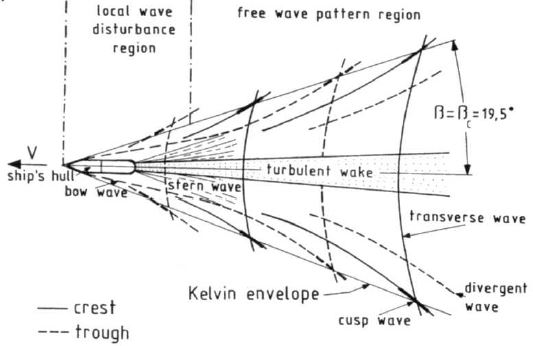
Figure 8.12 - Kelvin waves generated by a ship2Source:Melsheimer, C.H.R.I.S.T.I.A.N., Lim, H. and Shen, C., 1999, November. Observation and analysis of ship wakes in ERS SAR and SPOT images. In Proc. 20th Asian Conf. Remote Sensing (Vol. 1, pp. 554-559) |
Wave definition
The Kelvin wave is constituted by two types of wave systems generated by the moving pressure source or the vessel, for deep water systems. They are:
- Transverse waves: Wave train that moves along the center line of the vessel. The wavelength of these waves is proportional to the speed of the vessel.
- Divergent waves: They live within the Kelvin envelope. The envelope is made by 19.5° lines on either side of the ship center line. The angle of the envelope is fixed for deep water sailing, and does not change with the speed of the ship. The divergent waves offer very less resistance against the ship's forward motion.
When the vessel sails through shallow water, the transverse wave train disappears and only the divergent wave systems exists.